
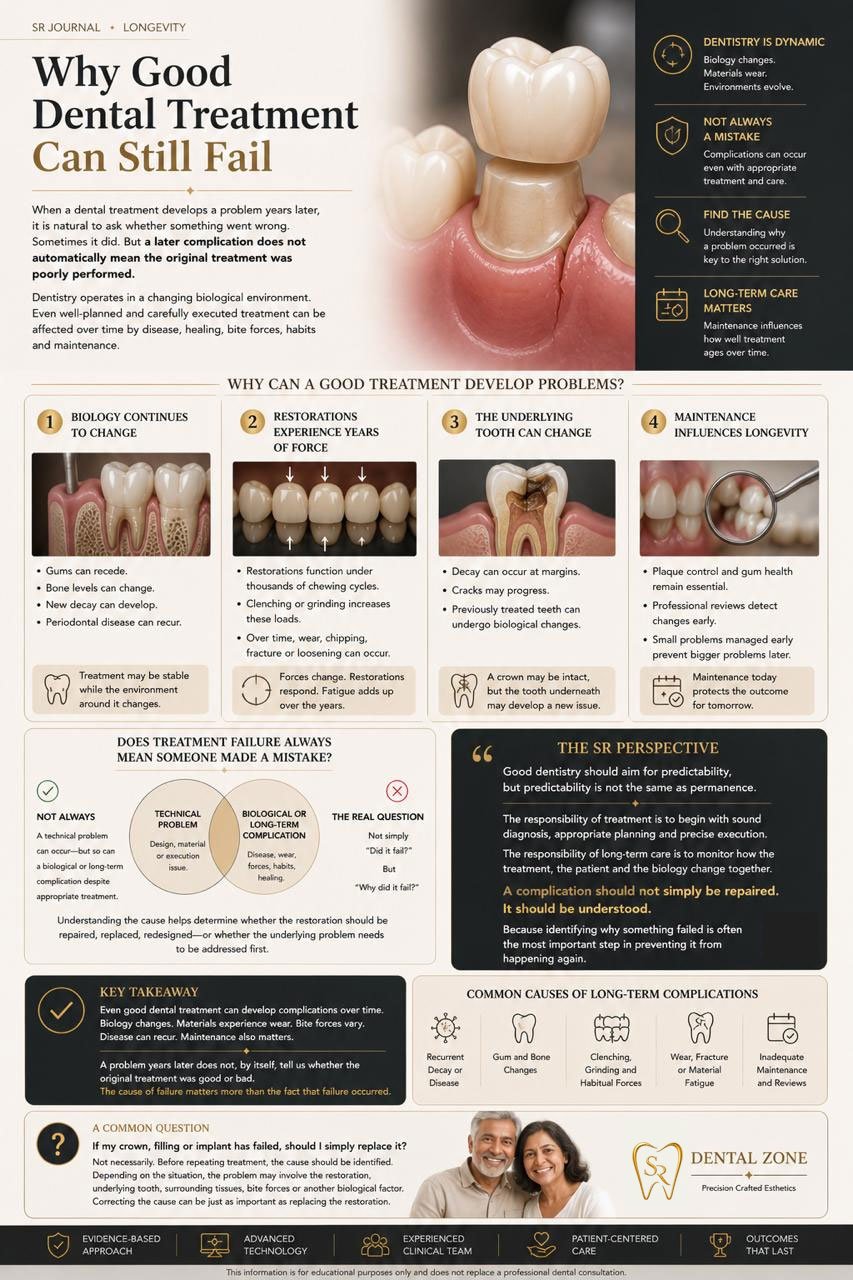
Why Good Dental Treatment Can Still Fail?
📅 Sep 7, 2026 | 🕒 5 min read | 👤 Dr. G. S. Suman Reddy
When a dental treatment develops a problem years later, it is natural to ask whether something went wrong.
Sometimes it did. But a later complication does not automatically mean the original treatment was poorly performed.
Dentistry operates in a changing biological environment. Even well-planned and carefully executed treatment can be affected over time by disease, healing, bite forces, habits and maintenance.
Why Can a Good Treatment Develop Problems?

1. Biology continues to change
Dental treatment may restore a tooth or replace what has been lost, but it cannot stop biological change.
Gums can recede. Bone levels can change. New decay can develop. Periodontal disease can recur.
Treatment may be stable while the environment around it changes.
2. Restorations experience years of force
Crowns, fillings, veneers and implant restorations function under repeated chewing forces every day.
Clenching or grinding can increase these loads considerably.
Over time, restorations may wear, chip, fracture or loosen—even when they were initially well designed and fitted.

3. The underlying tooth can change
A crown may remain intact while the tooth supporting it develops a new problem.
Decay can occur at restoration margins, cracks may progress, and previously treated teeth may undergo biological changes.
This is why the condition of the whole tooth-restoration system matters.

4. Maintenance influences longevity
Dental treatment does not become maintenance-free once completed.
Plaque control, periodontal health, professional reviews and appropriate preventive care continue to influence the tissues and structures supporting the treatment.
Small problems detected early are often easier to manage than problems discovered after they have progressed.
Does Treatment Failure Always Mean Someone Made a Mistake?
No. There is an important difference between a technical problem and a biological or long-term complication.
A restoration may fail because of poor design or execution—but complications can also occur despite appropriate treatment.
The correct question is therefore not simply: "Did it fail?"
It is: "Why did it fail?"
Understanding the cause helps determine whether the restoration should be repaired, replaced, redesigned—or whether the underlying biological problem needs to be addressed first.
The SR Perspective
Good dentistry should aim for predictability, but predictability is not the same as permanence.
The responsibility of treatment is to begin with sound diagnosis, appropriate planning and precise execution.
The responsibility of long-term care is to monitor how the treatment, the patient and the biology change together.
A complication should not simply be repaired. It should be understood. Because identifying why something failed is often the most important step in preventing it from happening again.
Key Takeaway
There is no guaranteed lifespan for a dental implant.
Even good dental treatment can develop complications over time.
Biology changes. Materials experience wear. Bite forces vary. Disease can recur. Maintenance also matters.
A problem years later therefore does not, by itself, tell us whether the original treatment was good or bad. The cause of failure matters more than the fact that failure occurred.
