
How Long Does a Dental Crown Last? What Determines Its Lifespan
📅 Sep 7, 2026 | 🕒 5 min read | 👤 Dr. G. S. Suman Reddy
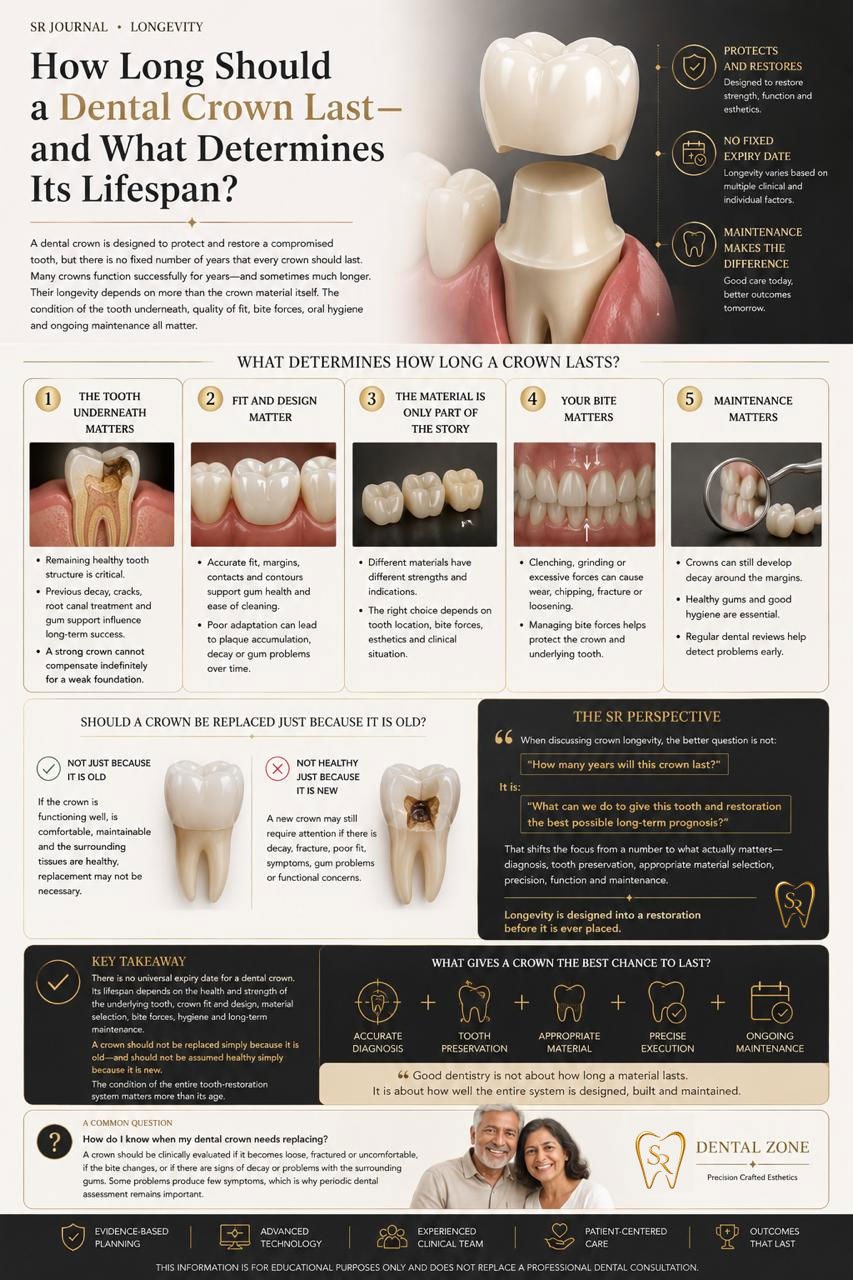
A dental crown is designed to protect and restore a compromised tooth, but there is no fixed number of years that every crown should last.
Many crowns function successfully for years—and sometimes much longer. Their longevity depends on more than the crown material itself. The condition of the tooth underneath, quality of fit, bite forces, oral hygiene and ongoing maintenance all matter.
What Determines How Long a Crown Lasts?

1. The tooth underneath matters
A crown can only be as predictable as the foundation supporting it.
The amount of healthy remaining tooth structure, previous decay, cracks, root canal treatment and periodontal support can all influence long-term prognosis.
A strong crown cannot compensate indefinitely for a weak biological foundation.

2. Fit and design matter
A well-made crown should integrate accurately with the prepared tooth and surrounding tissues.
Margins, contacts, contours and bite all need careful consideration. Poor adaptation can make cleaning more difficult or create conditions that compromise the tooth or gums over time.

3. The material is only part of the story
Modern crowns can be made from different ceramics, zirconia, metal-ceramic and other restorative materials.
Material selection matters—but there is no universally "best" crown material for every tooth.
The appropriate choice depends on where the tooth is located, available space, bite forces, esthetic requirements and the clinical situation.

4. Your bite matters
Crowns experience thousands of chewing cycles over time.
Clenching, grinding or excessive forces may increase the risk of wear, chipping, fracture or other complications.
For some patients, protecting the restoration also means managing the forces acting on it.

5. Maintenance matters
A crowned tooth can still develop problems.
Decay may occur around crown margins, and the surrounding gums and supporting tissues still require regular care.
Good home hygiene and appropriate professional reviews allow problems to be identified earlier—often before they become more extensive.
Should a Crown Be Replaced Just Because It Is Old?
No. Age alone is not a reason to replace a functioning crown.
If a crown remains clinically acceptable, comfortable, maintainable and the underlying tooth and surrounding tissues are healthy, replacement may not be necessary simply because a certain number of years has passed.
Conversely, a relatively new crown may require attention if there is decay, fracture, poor fit, recurrent symptoms, periodontal problems or functional concerns.
The SR Perspective
When discussing crown longevity, the better question is not: "How many years will this crown last?"
It is: "What can we do to give this tooth and restoration the best possible long-term prognosis?"
That shifts the focus from a number to what actually matters—diagnosis, tooth preservation, appropriate material selection, precision, function and maintenance.
Longevity is designed into a restoration before it is ever placed.
Key Takeaway
There is no universal expiry date for a dental crown.
Its lifespan depends on the health and strength of the underlying tooth, crown fit and design, material selection, bite forces, hygiene and long-term maintenance.
A crown should therefore not be replaced simply because it is old—and should not be assumed healthy simply because it is new.
The condition of the entire tooth-restoration system matters more than its age.
