
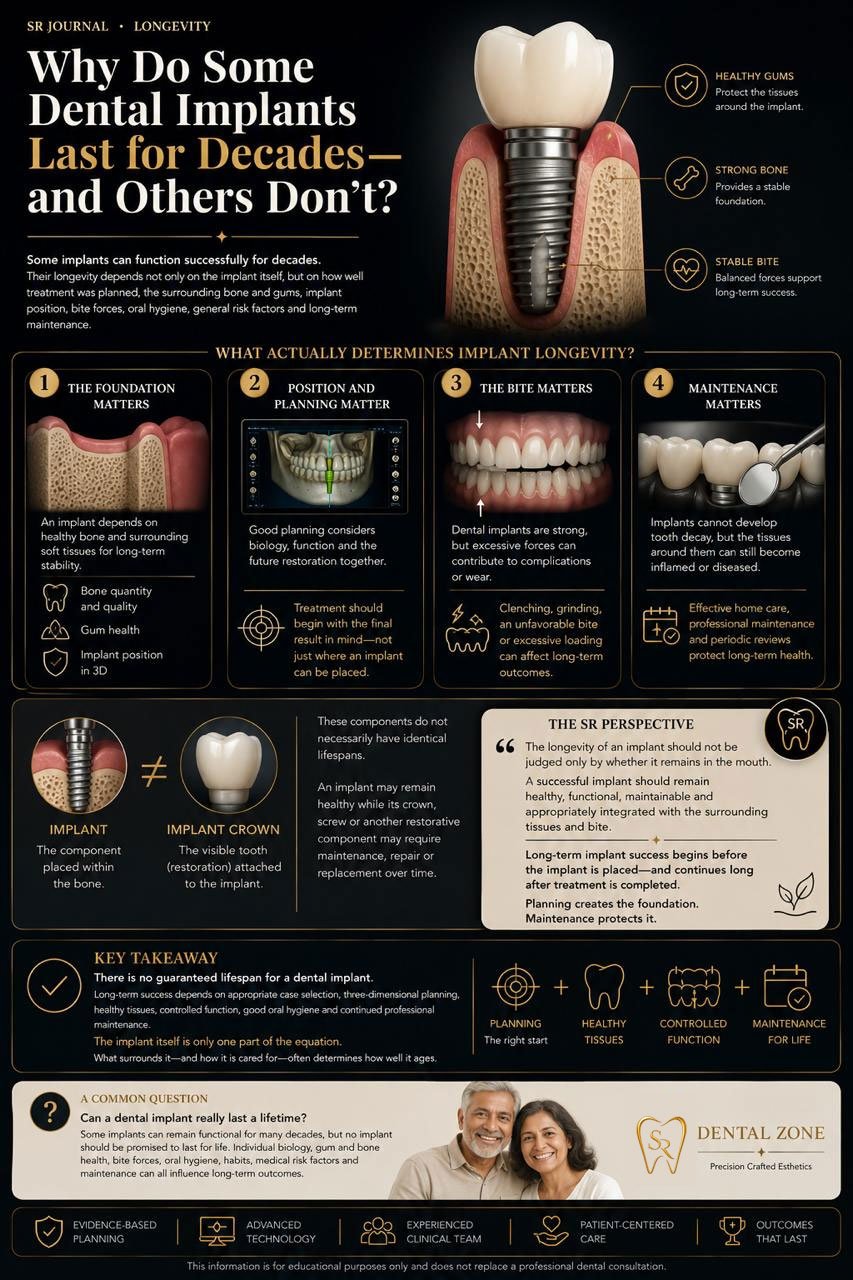
Why Do Some Dental Implants Last for Decades and Others Don't?
📅 Sep 7, 2026 | 🕒 5 min read | 👤 Dr. G. S. Suman Reddy
Dental implants are designed as long-term replacements for missing teeth, but there is no single lifespan that applies to every implant.
Some implants can function successfully for decades. Their longevity depends not only on the implant itself, but on how well treatment was planned, the surrounding bone and gums, implant position, bite forces, oral hygiene, general risk factors and long-term maintenance.
What Actually Determines Implant Longevity?

1. The foundation matters
An implant depends on healthy bone and surrounding soft tissues for long-term stability.
The quantity and quality of available bone, gum health and the three-dimensional position of the implant all influence how well the implant and its restoration can be maintained over time.

2. Position and planning matter
An implant that integrates successfully into bone still needs to be positioned appropriately for the final tooth.
Good planning considers biology, function and the future restoration together.
This is why implant treatment should ideally begin with the final result in mind—not simply with where an implant can be placed.

3. The bite matters
Dental implants are strong, but they are not immune to excessive forces.
Clenching, grinding, an unfavorable bite or excessive loading can contribute to wear or complications involving the implant restoration and its components.
Long-term success therefore involves managing how the implant functions, not merely whether it has healed.

4. Maintenance matters
Implants cannot develop tooth decay, but the tissues around them can still become inflamed or diseased.
Effective home care, professional maintenance and periodic clinical review help identify changes before they become more difficult to manage.
Is the Implant and the Implant Crown the Same Thing?
No. The implant is the component positioned within the bone. The visible tooth is usually an implant-supported restoration attached to it.
These components do not necessarily have identical lifespans.
An implant may remain healthy while its crown, screw or another restorative component requires maintenance, repair or replacement over time.
That distinction is important when discussing how long an "implant" lasts.
The SR Perspective
The longevity of an implant should not be judged only by whether it remains in the mouth.
A successful implant should remain healthy, functional, maintainable and appropriately integrated with the surrounding tissues and bite.
Long-term implant success begins before the implant is placed—and continues long after treatment is completed.
Planning creates the foundation. Maintenance protects it.
Key Takeaway
There is no guaranteed lifespan for a dental implant.
Long-term success depends on appropriate case selection, three-dimensional planning, healthy tissues, controlled function, good oral hygiene and continued professional maintenance.
The implant itself is only one part of the equation. What surrounds it—and how it is cared for—often determines how well it ages.
