
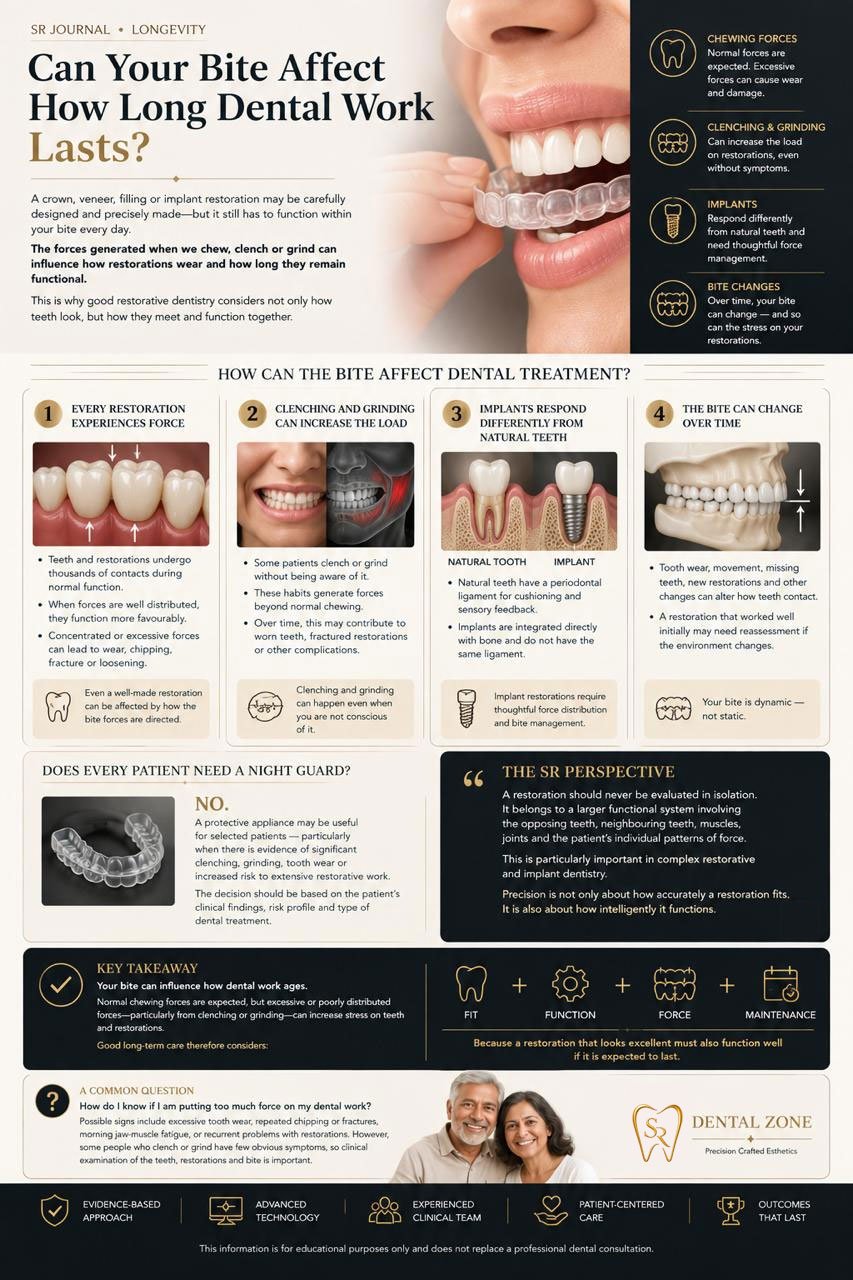
Can Your Bite Affect How Long Dental Work Lasts?
📅 Sep 7, 2026 | 🕒 5 min read | 👤 Dr. G. S. Suman Reddy
A crown, veneer, filling or implant restoration may be carefully designed and precisely made—but it still has to function within your bite every day.
The forces generated when we chew, clench or grind can influence how restorations wear and how long they remain functional.
This is why good restorative dentistry considers not only how teeth look, but how they meet and function together.
How Can the Bite Affect Dental Treatment?

1. Every restoration experiences force
Teeth and restorations undergo thousands of contacts during normal function.
When those forces are appropriately distributed, the teeth and restorations generally function more favourably.
When excessive or unfavourable forces repeatedly concentrate on a particular area, however, they may contribute to wear, chipping, fracture or loosening of restorative components.

2. Clenching and grinding can increase the load
Some patients clench or grind their teeth, often without being aware of it.
These habits can generate forces beyond those experienced during normal chewing.
Over time, this may contribute to worn teeth, fractured restorations or other mechanical complications.

3. Implants respond differently from natural teeth
Natural teeth are supported by a periodontal ligament that provides a degree of cushioning and sensory feedback.
Dental implants are integrated directly with bone and do not have the same ligament.
This does not make implants inherently fragile, but it means implant-supported restorations require thoughtful consideration of force distribution and bite.

4. The bite can change over time
Occlusion is not necessarily static.
Tooth wear, tooth movement, missing teeth, new restorations and changes elsewhere in the mouth can alter how teeth contact.
A restoration that functioned well initially may therefore need reassessment if the surrounding dental environment changes.
Does Every Patient Need a Night Guard?
No. A protective appliance may be useful for selected patients—particularly when there is evidence of significant clenching, grinding, tooth wear or increased risk to extensive restorative work.
But it should not automatically be prescribed to everyone.
The decision should be based on the patient's clinical findings, risk profile and type of dental treatment.
The SR Perspective
A restoration should never be evaluated in isolation.
It belongs to a larger functional system involving the opposing teeth, neighbouring teeth, muscles, joints and the patient's individual patterns of force.
This is particularly important in complex restorative and implant dentistry.
Precision is not only about how accurately a restoration fits. It is also about how intelligently it functions. Designing for longevity means understanding both.
Key Takeaway
Your bite can influence how dental work ages.
Normal chewing forces are expected, but excessive or poorly distributed forces—particularly from clenching or grinding—can increase stress on teeth and restorations.
Good long-term care therefore considers: Fit + Function + Force + Maintenance
Because a restoration that looks excellent must also function well if it is expected to last.
