
When Should an Old Crown, Filling or Implant Restoration Be Replaced?
📅 Sep 7, 2026 | 🕒 5 min read | 👤 Dr. G. S. Suman Reddy
Dental restorations do not come with a universal expiry date.
A crown may have been in place for many years and still be functioning well. A much newer filling or implant restoration may develop a problem sooner.
The decision to replace dental work should be based on its condition, the health of the structures supporting it and its long-term prognosis—not simply its age.
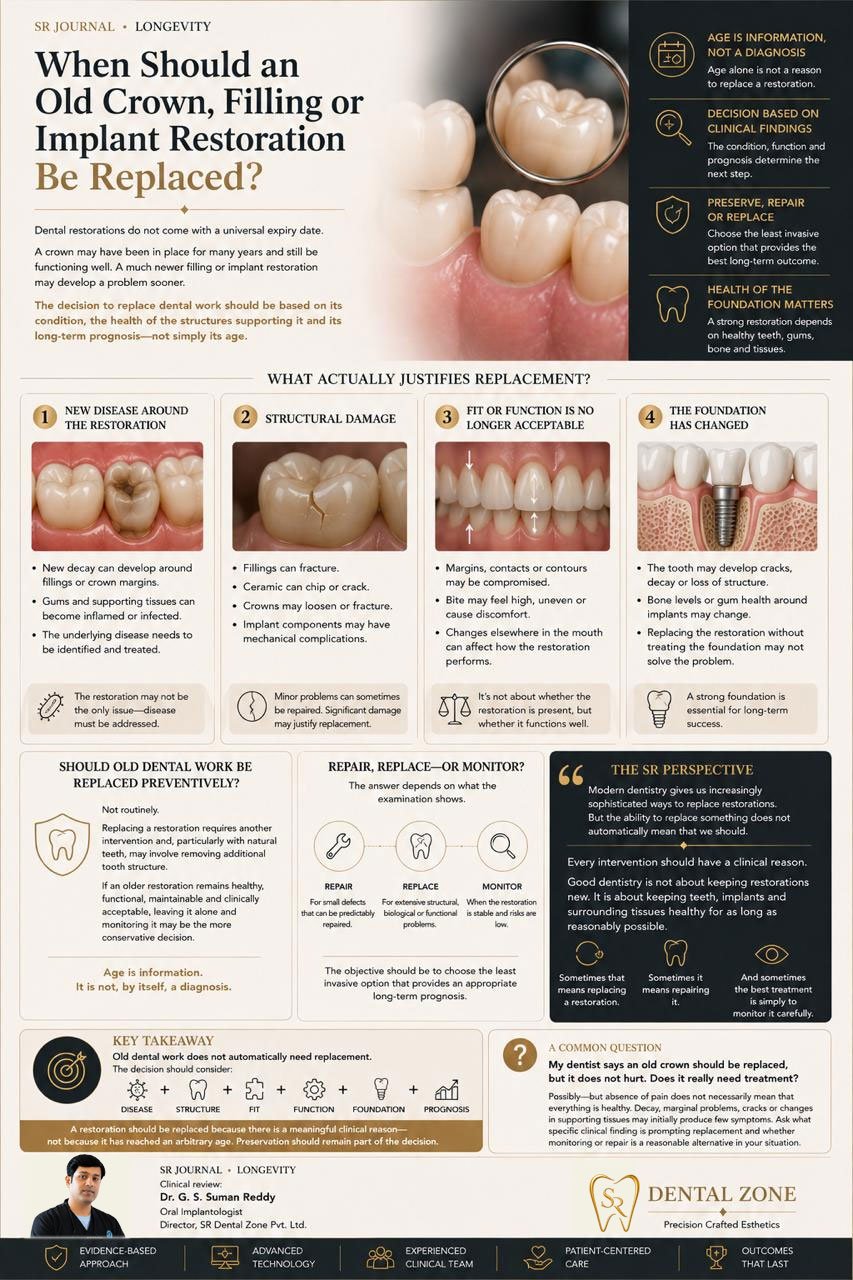
What Actually Justifies Replacement?

1. New disease around the restoration
Natural teeth can develop new decay around fillings and crown margins.
Similarly, the tissues surrounding teeth and implants can develop inflammation or periodontal problems.
In these situations, the restoration itself may not be the only concern. The underlying disease needs to be identified and treated.

2. Structural damage
Restorations are exposed to years of chewing forces.
A filling may fracture. Ceramic may chip. A crown may crack or loosen. Components of an implant restoration may also experience mechanical complications.
Minor problems can sometimes be repaired. Others may make replacement the more predictable option.

3. The fit or function is no longer acceptable
A restoration may need attention if its margins, contacts, contours or bite are compromising health or function.
Changes elsewhere in the mouth can also alter how an older restoration performs.
What matters is not simply whether the restoration is still present—but whether it is still functioning appropriately.

4. The underlying tooth or supporting tissues have changed
Sometimes the restoration remains intact while its foundation changes.
A tooth may develop a crack, decay or loss of supporting tissue. Around an implant, changes in the surrounding bone or soft tissues may affect prognosis.
Replacing the visible restoration without understanding the foundation may therefore fail to address the real problem.
Should Old Dental Work Be Replaced Preventively?
Not routinely. Replacing a restoration requires another intervention and, particularly with natural teeth, may involve removing additional tooth structure.
If an older restoration remains healthy, functional, maintainable and clinically acceptable, leaving it alone and monitoring it may sometimes be the more conservative decision.
Age is information. It is not, by itself, a diagnosis.
Repair, Replace—or Monitor?
The answer depends on what the examination shows. A small defect may sometimes be monitored or repaired. More extensive structural, biological or functional problems may justify replacement.
The objective should be to choose the least invasive option that provides an appropriate long-term prognosis.
The SR Perspective
Modern dentistry gives us increasingly sophisticated ways to replace restorations. But the ability to replace something does not automatically mean that we should.
Every intervention should have a clinical reason. Good dentistry is not about keeping restorations new. It is about keeping teeth, implants and surrounding tissues healthy for as long as reasonably possible.
Sometimes that means replacing a restoration. Sometimes it means repairing it. And sometimes the best treatment is simply to monitor it carefully.
Key Takeaway
Old dental work does not automatically need replacement.
The decision should consider: Disease + Structure + Fit + Function + Foundation + Prognosis
A restoration should be replaced because there is a meaningful clinical reason—not because it has reached an arbitrary age. Preservation should remain part of the decision.
