
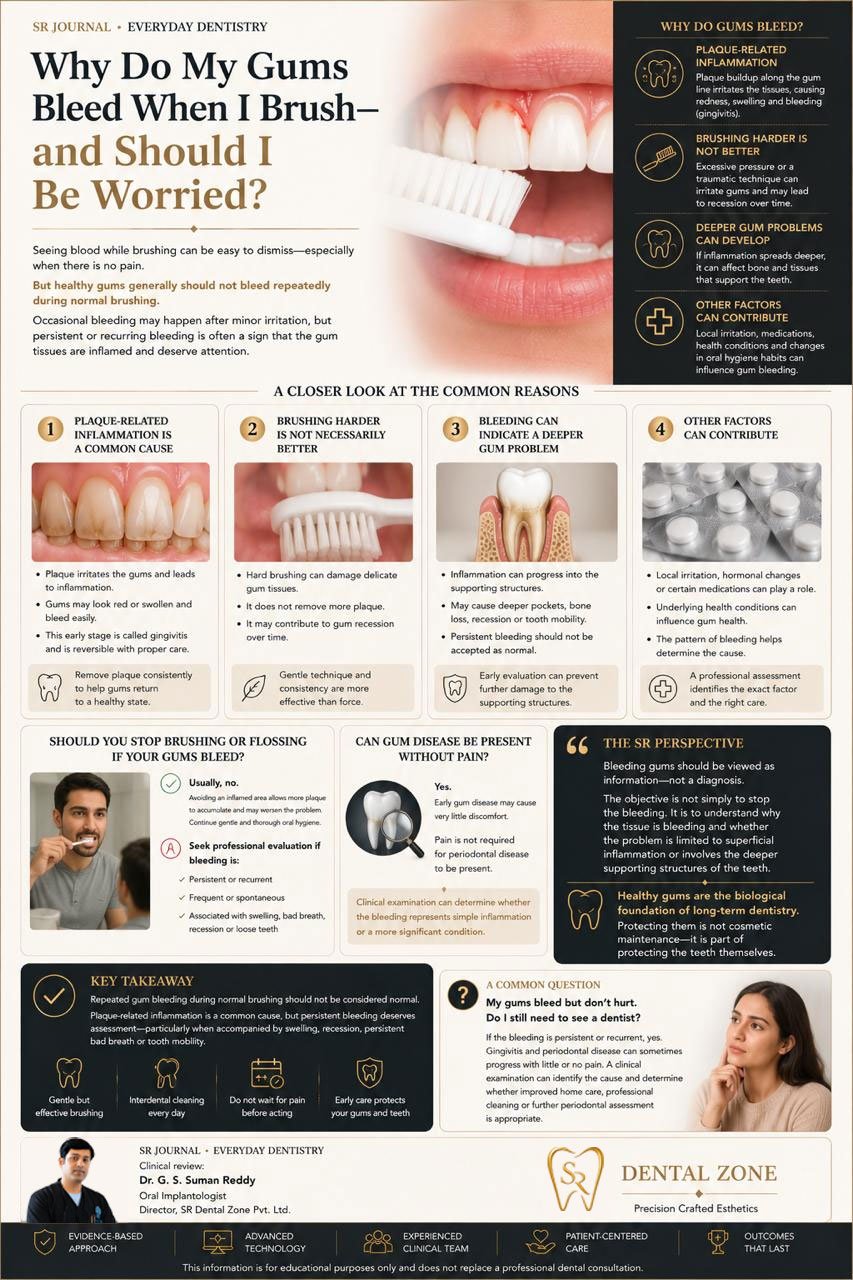
Why Do My Gums Bleed When I Brush—and Should I Be Worried?
📅 Sep 7, 2026 | 🕒 5 min read | 👤 Dr. G. S. Suman Reddy
Seeing blood while brushing can be easy to dismiss—especially when there is no pain.
But healthy gums generally should not bleed repeatedly during normal brushing.
Occasional bleeding may happen after minor irritation, but persistent or recurring bleeding is often a sign that the gum tissues are inflamed and deserve attention.
Why Do Gums Bleed?

1. Plaque-related inflammation is a common cause
When dental plaque accumulates around the gum line, the tissues can become inflamed.
This early stage of gum inflammation is commonly called gingivitis.
The gums may appear red or swollen and can bleed more easily during brushing or flossing.

2. Brushing harder is not necessarily better
Bleeding does not mean the gums need to be scrubbed more aggressively.
Excessive brushing pressure or a traumatic technique can irritate the gums and may contribute to gum recession over time.
Effective plaque removal depends more on technique and consistency than force.

3. Bleeding can sometimes indicate a deeper gum problem
If inflammation progresses into the supporting structures around the teeth, periodontal disease may develop.
Depending on the situation, this can be associated with deeper gum pockets, loss of supporting bone, gum recession or eventually tooth mobility.
This is why persistent bleeding should not simply be accepted as normal.

4. Other factors can contribute
Bleeding may also be influenced by local irritation, changes in oral hygiene habits, certain medications or underlying health factors.
The pattern matters. Bleeding from one specific area may have a different explanation from generalized bleeding affecting much of the mouth.
Should You Stop Brushing or Flossing If Your Gums Bleed?
Usually, no. Avoiding an inflamed area can allow more plaque to accumulate and may make the problem worse.
Instead, continue gentle and thorough oral hygiene without aggressive scrubbing.
If bleeding persists despite appropriate cleaning—or is frequent, spontaneous or associated with swelling, bad breath, gum recession or loose teeth—it should be professionally evaluated.
Can Gum Disease Be Present Without Pain?
Yes. Early gum disease may cause very little discomfort.
This is one reason bleeding gums are worth paying attention to: pain is not required for periodontal disease to be present.
Clinical examination can determine whether the bleeding represents simple gingival inflammation or a more significant periodontal condition.
The SR Perspective
Yes. Early gum disease may cause very little discomfort.
This is one reason bleeding gums are worth paying attention to: pain is not required for periodontal disease to be present.
Clinical examination can determine whether the bleeding represents simple gingival inflammation or a more significant periodontal condition.
Key Takeaway
Repeated gum bleeding during normal brushing should not be considered normal.
Plaque-related inflammation is a common cause, but persistent bleeding deserves assessment—particularly when accompanied by swelling, recession, persistent bad breath or tooth mobility.
Brush gently but effectively, maintain interdental cleaning and do not wait for pain before paying attention to gum health.
