
How Often Should You Really Get Your Teeth Cleaned?
📅 Sep 7, 2026 | 🕒 5 min read | 👤 Dr. G. S. Suman Reddy
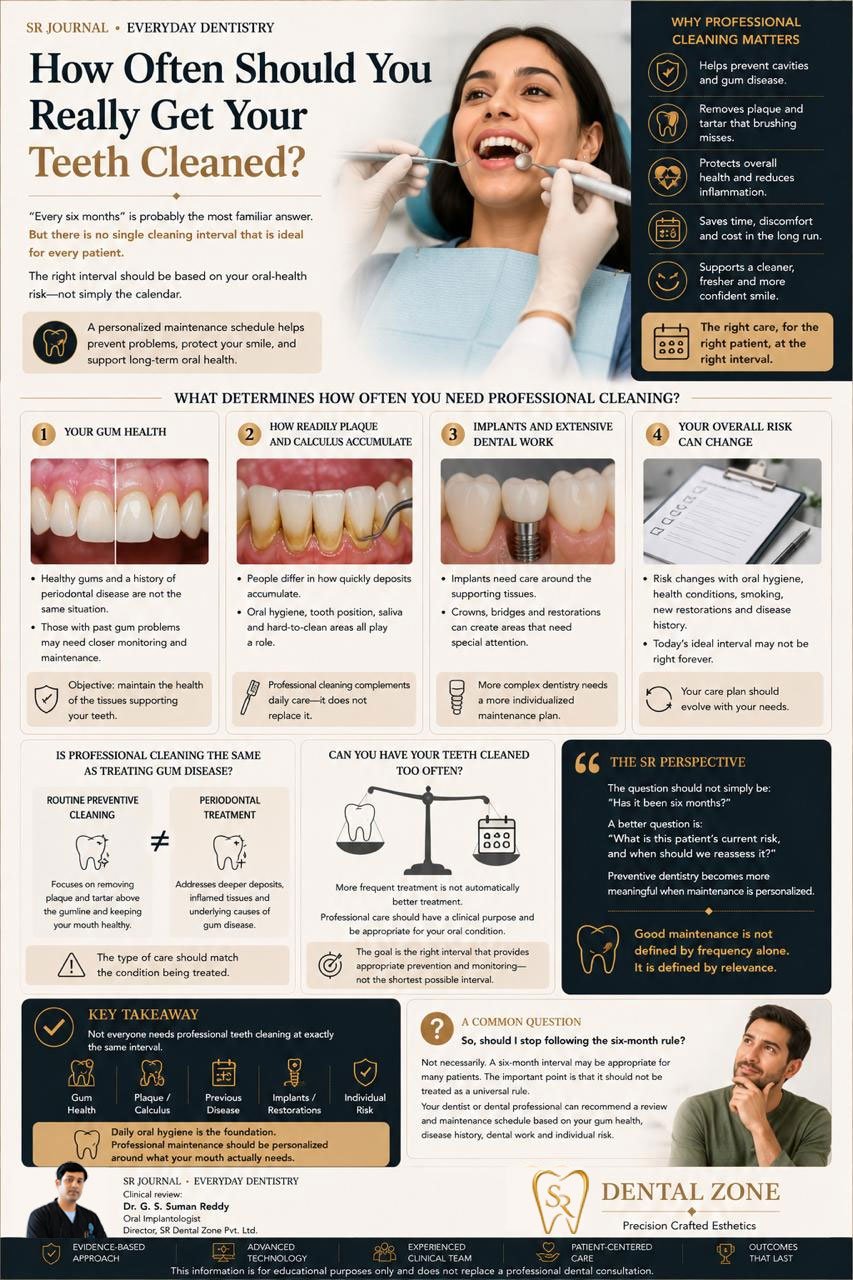
"Every six months" is probably the most familiar answer to how often teeth should be professionally cleaned.
But there is no single cleaning interval that is ideal for every patient.
Some people remain stable with relatively routine preventive care. Others accumulate plaque or calculus more readily, have a history of periodontal disease, implants or complex dental work, and may benefit from closer professional maintenance.
The right interval should be based on your oral-health risk—not simply the calendar.
What Determines How Often You Need Professional Cleaning?

1. Your gum health
Healthy gums and a history of periodontal disease are not the same clinical situation.
Patients who have previously experienced loss of periodontal support may require closer monitoring and maintenance than someone with consistently healthy gums.
The objective is not simply cleaner teeth—it is maintaining the health of the tissues supporting them.

2. How readily plaque and calculus accumulate
People differ considerably in how quickly deposits accumulate.
Oral hygiene technique, tooth position, salivary factors and areas that are difficult to clean can all influence plaque and calculus retention.
Professional cleaning should therefore complement effective daily home care—not replace it.

3. Implants and extensive dental work may change maintenance needs
Implants cannot develop tooth decay, but the tissues surrounding them still require care.
Crowns, bridges and other restorations can also create areas that require particular attention during home and professional maintenance.
The more complex the dentistry, the more important an individualized maintenance strategy becomes.
This is why persistent bleeding should not simply be accepted as normal.

4. Your overall risk can change
Maintenance needs are not necessarily permanent.
Changes in oral hygiene, gum health, new restorations, smoking, certain medical factors or previous patterns of dental disease can alter risk over time.
The appropriate interval today may therefore not always be the appropriate interval in the future.
Is Professional Cleaning the Same as Treating Gum Disease?
No. Routine preventive cleaning and periodontal treatment are not interchangeable.
If periodontal disease is present, treatment may need to address deeper deposits, inflamed tissues and other disease-related factors.
After periodontal treatment, some patients may also require a structured maintenance programme.
The type of care should match the condition being treated.
Can You Have Your Teeth Cleaned Too Often?
More frequent treatment is not automatically better treatment.
Professional care should have a clinical purpose and should be performed appropriately for the patient's oral condition.
The objective is not to create the shortest possible interval.
It is to determine the interval that provides appropriate disease prevention and monitoring without unnecessary intervention.
The SR Perspective
The question should not simply be: "Has it been six months?"
A better question is: "What is this patient's current risk, and when should we reassess it?"
Preventive dentistry becomes more meaningful when maintenance is personalized.
Good maintenance is not defined by frequency alone. It is defined by relevance.
The right care, for the right patient, at the right interval.
Key Takeaway
Not everyone needs professional teeth cleaning at exactly the same interval.
The appropriate schedule depends on factors such as:
Gum health + Plaque/calculus accumulation + Previous disease + Implants/restorations + Individual risk
Daily oral hygiene remains the foundation.
Professional maintenance should then be personalized around what your mouth actually needs.
