
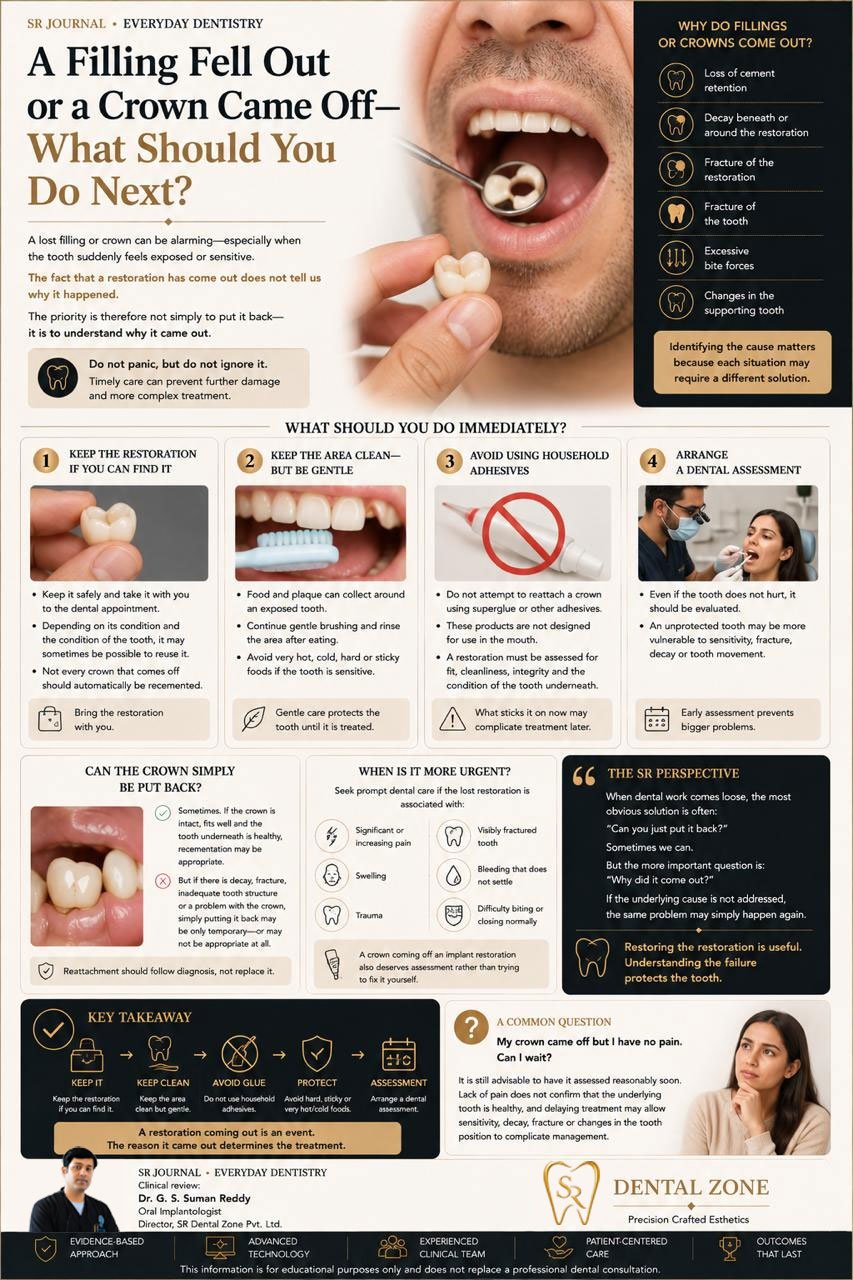
A Filling Fell Out or a Crown Came Off—What Should You Do Next?
📅 Sep 7, 2026 | 🕒 5 min read | 👤 Dr. G. S. Suman Reddy
A lost filling or crown can be alarming—especially when the tooth suddenly feels exposed or sensitive.
But the fact that a restoration has come out does not tell us why it happened.
Sometimes the restoration itself has failed. In other cases, the tooth underneath has changed because of decay, fracture or loss of supporting tooth structure.
The priority is therefore not simply to put it back—it is to understand why it came out.
What Should You Do Immediately?

1. Keep the restoration if you can find it
If a crown or larger restoration has come out, keep it safely and take it with you to the dental appointment.
Depending on its condition and the condition of the tooth, it may sometimes be possible to reuse it.
But not every crown that comes off should automatically be recemented.

2. Keep the area clean—but be gentle
Food and plaque can collect around an exposed tooth.
Continue gentle brushing and rinse the area after eating. Avoid repeatedly touching or testing the tooth.
If the tooth is sensitive, very hot, cold, hard or sticky foods may be uncomfortable until it is assessed.

3. Avoid using household adhesives
Do not attempt to permanently reattach a crown using superglue or other household adhesives.
These products are not designed for use inside the mouth and may interfere with appropriate dental treatment.
A restoration needs to be assessed for fit, cleanliness, structural integrity and the condition of the tooth underneath before it is reattached.

4. Arrange a dental assessment
Even if the tooth does not hurt, it should be evaluated.
An unprotected tooth may be more vulnerable to sensitivity, further fracture, food accumulation or movement of neighbouring and opposing teeth if left untreated for an extended period.
Why Do Fillings or Crowns Come Out?
There is no single explanation. Possible reasons include:
Loss of cement retention · Decay beneath or around the restoration · Fracture of the restoration · Fracture of the tooth · Excessive bite forces · Changes in the supporting tooth.
Identifying the cause matters because each situation may require a different solution.
Can Gum Disease Be Present Without Pain?
Can the Crown Simply Be Put Back? Sometimes.
If the crown remains intact, still fits accurately and the underlying tooth is healthy, recementation may be appropriate.
But if there is decay, fracture, inadequate remaining tooth structure or a problem with the crown itself, simply putting it back may provide only a temporary solution—or may not be appropriate at all.
Reattachment should follow diagnosis, not replace it.
When Is It More Urgent?
Seek prompt dental care if the lost restoration is associated with:
- Significant or increasing pain,
- Swelling,
- Trauma,
- A visibly fractured tooth,
- Bleeding that does not settle, or
- Difficulty biting or closing the teeth normally.
A crown coming off an implant restoration also deserves assessment rather than repeated attempts to tighten or replace it yourself.
The SR Perspective
When dental work comes loose, the most obvious solution is often: "Can you just put it back?"
Sometimes we can. But the more important question is: "Why did it come out?"
If the underlying cause is not addressed, the same problem may simply happen again. Restoring the restoration is useful. Understanding the failure protects the tooth.
Key Takeaway
If a filling falls out or a crown comes off:
Keep it → Keep the area clean → Avoid household glue → Protect the tooth → Arrange an assessment
And remember: A restoration coming out is an event. The reason it came out determines the treatment.
