
Should Every Missing Tooth Be Replaced?
📅 Sep 1, 2026 | 🕒 5 min read | 👤 Dr. G. S. Suman Reddy
Losing a tooth naturally raises the question: Does the space always need to be replaced?
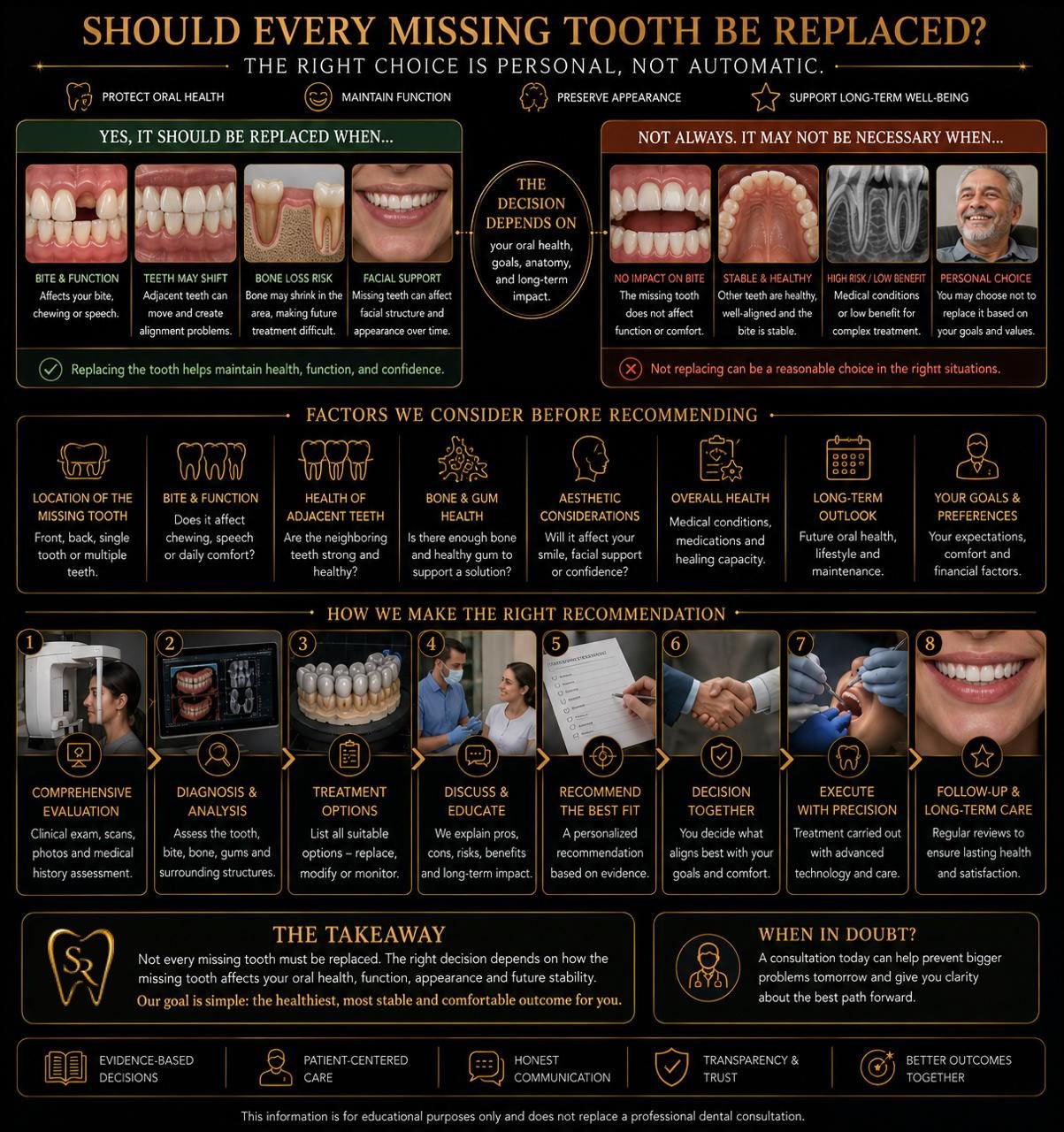
Not necessarily. Not every missing tooth automatically requires replacement. The decision depends on which tooth is missing, its role in chewing and bite stability, neighbouring and opposing teeth, esthetic requirements and the long-term consequences of leaving the space untreated.
What Determines Whether Replacement Is Necessary?

1. Which tooth is missing?
The importance of a missing tooth varies with its position.
A front tooth can have significant esthetic and functional consequences, while the impact of certain missing back teeth may be very different.
The decision should therefore begin with what that particular tooth contributed to the mouth, rather than simply the presence of a gap.

2. Will the space affect the bite?
When a tooth is missing, neighbouring or opposing teeth may sometimes change position over time.
But this does not happen identically in every patient.
The existing bite, number and position of remaining teeth, chewing pattern and overall dental condition all need to be considered.

3. Is function actually compromised?
Replacement should have a purpose.
If the missing tooth affects chewing, speech, appearance or stability of the dental arch, restoring it may provide a meaningful benefit.
The question is not simply: "Can we replace this tooth?"
It is: "What do we gain by replacing it?"

4. What are the options?
When replacement is appropriate, possibilities may include a dental implant, bridge or removable solution, depending on the clinical situation.
Each involves different considerations—including neighbouring teeth, available bone, treatment complexity, maintenance and longevity.
Does Every Missing Tooth Need an Implant?
No. Dental implants are an excellent option for many missing teeth, but a missing tooth is not automatically an indication for an implant.
Good treatment planning first establishes whether replacement is necessary. Only then should we decide how the tooth should be replaced.
The SR Perspective
Modern dentistry gives us sophisticated ways to replace missing teeth.
But the availability of a treatment does not, by itself, create the need for that treatment.
The decision should begin with biology and function—not with the procedure.
Sometimes replacement meaningfully improves health, function or confidence. In selected situations, carefully monitoring an unreplaced space may also be reasonable.
Key Takeaway
Not every missing tooth automatically needs replacement.
The right decision depends on the tooth's position, function, bite, neighbouring teeth, esthetic requirements and the likely consequences of leaving the space untreated.
Treatment should provide a clear benefit—not simply fill a space because a space exists.
