
Save the Tooth or Replace It?
How Dentists Make the Decision
📅 Sep 1, 2026 | 🕒 5 min read | 👤 Dr. G. S. Suman Reddy
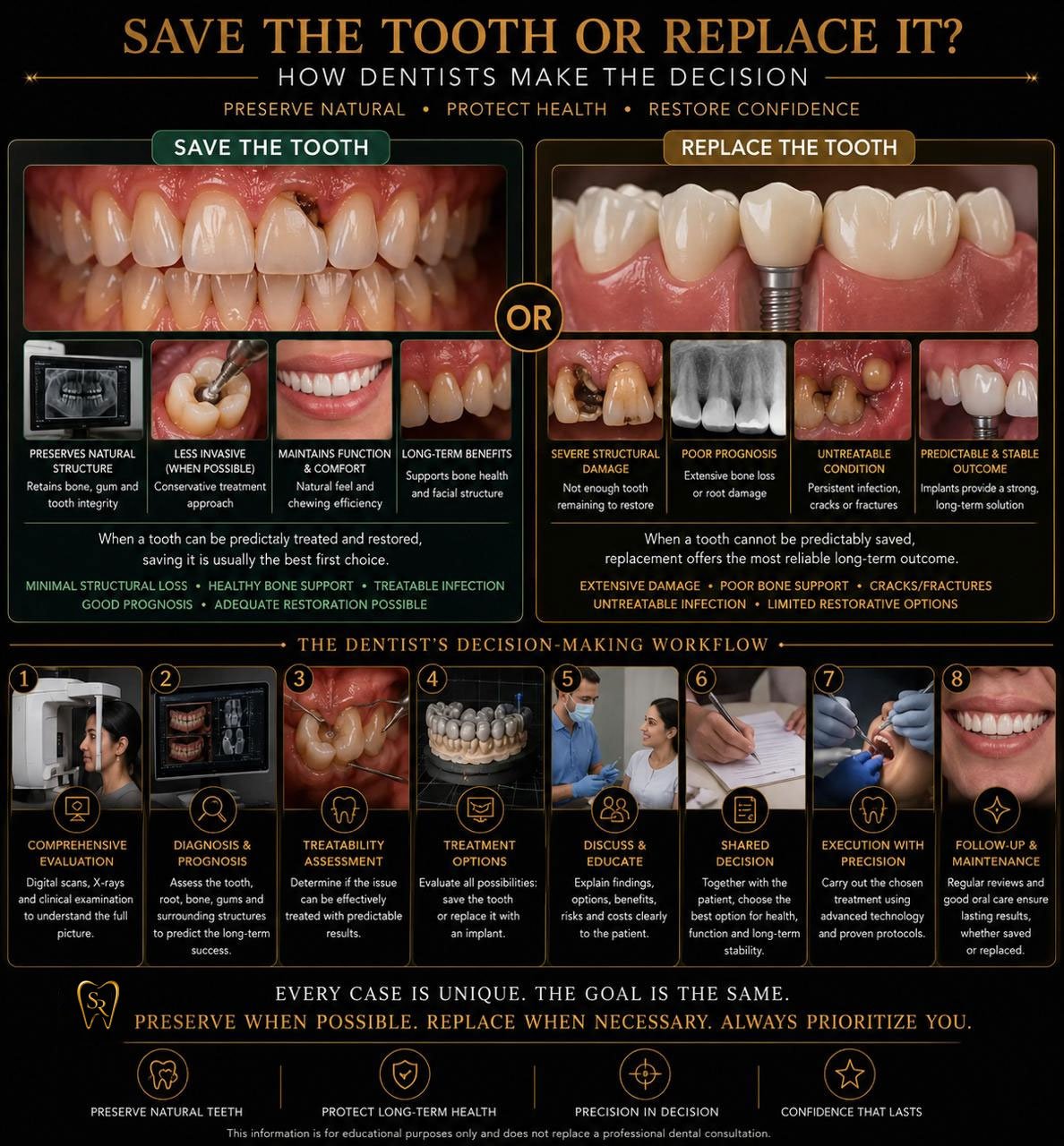
When a tooth is badly damaged or infected, the choice between saving it and replacing it isn't always straightforward.
A natural tooth is generally worth preserving when it can be predictably restored and maintained. But when structural damage, infection, fractures or loss of supporting tissues make its long-term prognosis poor, replacement may be the more sensible option.
What actually determines the decision?

1. How much healthy tooth remains?
A tooth may be treatable but still have too little sound structure to support a predictable long-term restoration.

2. What is happening below the gumline?
The roots, surrounding bone, gums, infection and possible fractures can be just as important as what is visible above the gum.

3. Can the tooth function predictably?
A restored tooth must withstand everyday chewing and bite forces. Simply being able to complete a procedure does not necessarily make it the best long-term treatment.

4. What happens if the tooth is removed?
Extraction is not the end of the decision. The space may need to be restored with an implant, bridge or another option—and sometimes replacement may not be necessary.
Natural Tooth or Implant?
An implant can be an excellent replacement for a tooth that cannot be predictably saved. But the availability of implant treatment is not, by itself, a reason to remove a restorable natural tooth.
Equally, repeatedly treating a tooth with a very poor prognosis simply because it is natural may not be sensible.
The SR Perspective
The real question isn't: "Can this tooth be saved?"
It is: "If we save it, can we expect it to remain healthy, functional and maintainable?"
Good dentistry is not about saving every tooth—or replacing teeth prematurely. It is about choosing the most predictable solution with the least unnecessary intervention.
Before You Decide Ask your dentist:
- Can this tooth be predictably restored?
- What is its long-term prognosis?
- What are the risks of trying to save it?
- If it is removed, does it necessarily need replacement?
Key Takeaway
Preserve a natural tooth when preservation is predictable. Replace it when the biological or structural prognosis makes long-term preservation unreasonable.
Every decision should be based on an individual clinical assessment.
