
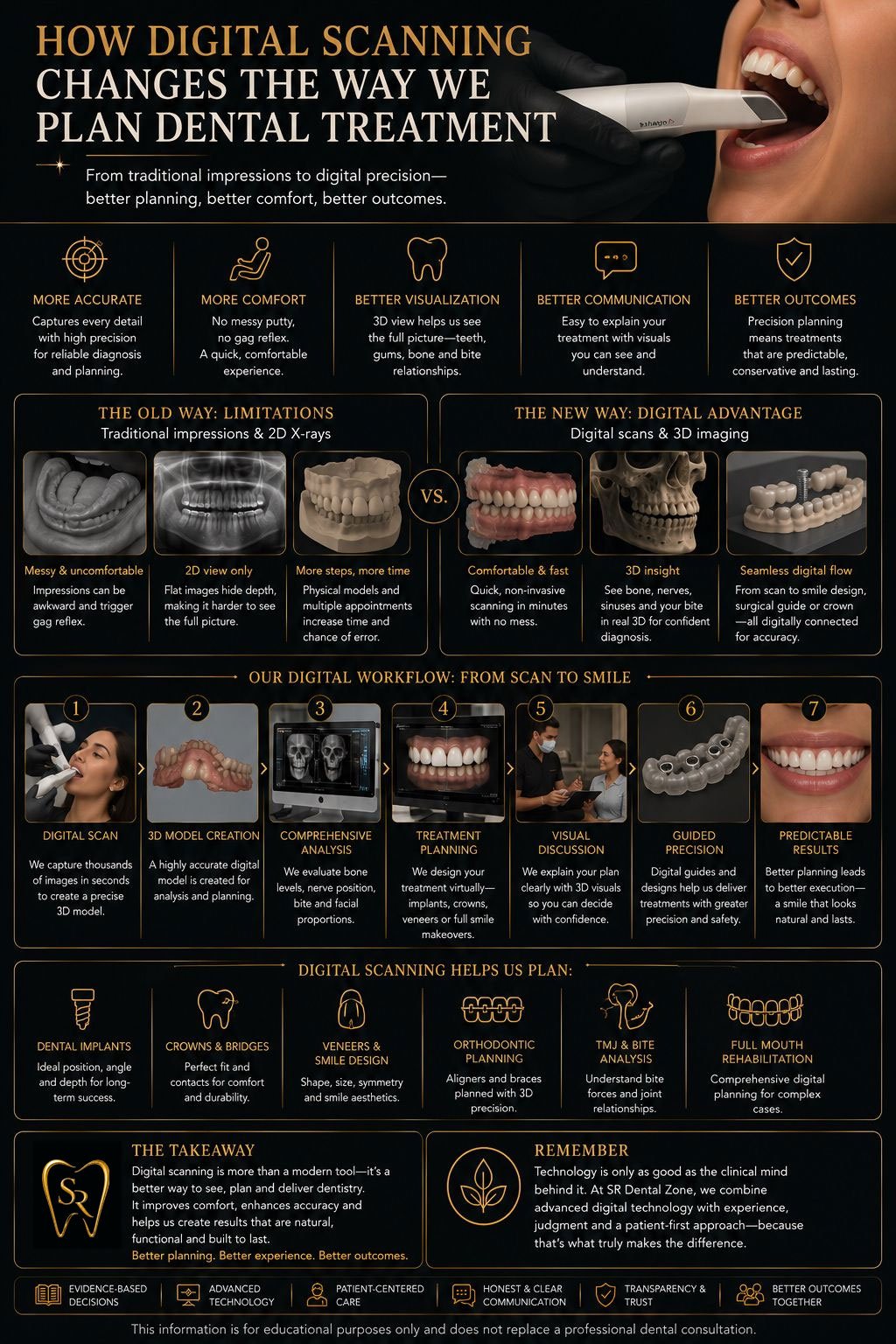
How Digital Scanning Changes the Way We Plan Dental Treatment?
📅 Sep 1, 2026 | 🕒 5 min read | 👤 Dr. G. S. Suman Reddy
For many years, dental impressions relied primarily on trays filled with impression material to create a physical model of the teeth.
Today, an intraoral scanner can capture the teeth and surrounding tissues digitally, creating a detailed three-dimensional model on screen.
But the real advantage is not simply replacing an impression tray. Digital scanning can change how treatment is visualised, planned, communicated and followed over time.
What Does a Digital Scan Actually Add?

1. A detailed 3D record
A digital scan creates a three-dimensional representation of the teeth and surrounding visible tissues.
The clinician can enlarge, rotate and examine this model from different perspectives, making certain relationships easier to understand than on a conventional physical model alone.

2. Treatment can be planned before it begins
Digital models can become part of a larger planning workflow.
Depending on the treatment, they may help evaluate tooth position, restorative space, bite relationships, smile proportions or the proposed shape of a future restoration.
This allows important decisions to be considered before irreversible treatment begins.

3. Different digital information can work together
One of the most useful aspects of digital dentistry is the ability to combine information.
For selected treatments, an intraoral scan may be integrated with photographs, facial information, CBCT imaging or computer-designed restorations.
The value comes not simply from having more data—but from connecting the right data to answer a clinical question.

4. Changes can be compared over time
Because digital scans can be stored, future scans may sometimes be compared with earlier records.
This can help clinicians visually assess changes in areas such as tooth position, wear or the dental condition over time when clinically relevant.
Does Digital Scanning Mean Conventional Impressions Are Obsolete?
No. Conventional impressions remain useful and may still be preferred in certain clinical situations.
Digital scanning is another method of capturing information—not a guarantee of a better result by itself.
Its value depends on what needs to be recorded, how accurately it can be captured and how that information will be used afterwards.
The SR Perspective
The most important part of digital scanning is not the scanner.
It is what becomes possible after the scan has been captured.
When digital information allows us to visualise treatment, combine diagnostic records and anticipate restorative requirements before treatment begins, technology becomes part of clinical planning rather than simply documentation.
A digital workflow should help us think ahead—not merely work digitally.
Key Takeaway
Digital scanning does more than replace traditional dental impressions.
It can create a detailed 3D record that supports treatment planning, communication, digital workflows and comparison over time.
But as with every technology, the scan itself is only information.
Its clinical value comes from how intelligently that information is used.
