
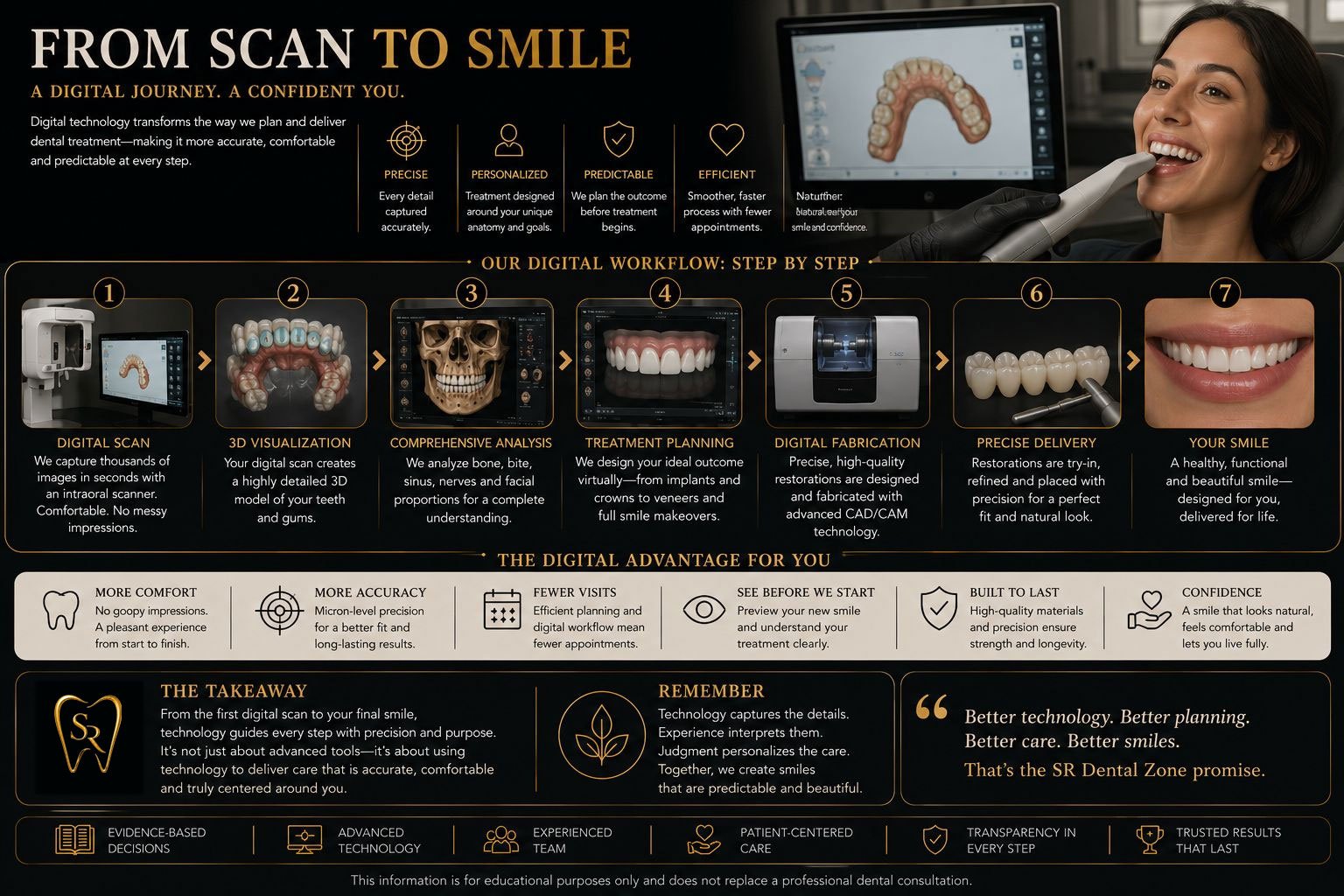
From Scan to Smile - What Actually Happens in a Digital Dental Workflow?
📅 Sep 1, 2026 | 🕒 5 min read | 👤 Dr. G. S. Suman Reddy
Digital dentistry can sound like one single technology, but in reality it is a sequence of connected steps.
A digital dental workflow usually begins with collecting information, then planning treatment, designing the restoration or procedure, producing it accurately, and finally verifying the result.
The value comes from how well those steps connect—not simply from using a scanner or computer.
What Happens Step by Step?

1. Capture
The process begins by collecting accurate records.
Depending on the treatment, this may include an intraoral scan, photographs, X-rays or 3D imaging.
The quality of every later step depends on the quality of this information.

2. Plan
The digital records are then used to understand the clinical situation.
The clinician may evaluate tooth position, bite, restorative space, implant anatomy, smile proportions or other relevant factors before treatment begins.
This is where digital dentistry becomes more than documentation..

3. Design
Once the treatment objective is clear, the future restoration or clinical outcome can often be designed digitally.
This may involve a crown, veneer, implant restoration, surgical guide or a larger restorative plan.
Digital design allows small details to be evaluated before they are transferred to the mouth.

4. Produce
Depending on the treatment, the design may then be manufactured through milling, 3D printing or a dental laboratory workflow.
But production is only one part of the process.
A precisely manufactured restoration is useful only if the diagnosis, planning and design were correct.

5. Verify
The final step is checking that the clinical result matches the intended plan.
Fit, bite, esthetics, tissue response and patient comfort still require careful clinical evaluation.
Digital technology does not remove the need for judgement at the end of treatment.
Does a Fully Digital Workflow Mean No Human Input?
No. A digital workflow may automate parts of the process, but important decisions still require clinical and technical judgement.
The dentist must determine what should be treated, how the result should function and whether the digital plan makes biological sense.
Similarly, the quality of laboratory and technical execution remains important.
The SR Perspective
The strength of digital dentistry is not that every step happens on a computer.
It is that information can move more accurately from diagnosis to planning, from planning to design, and from design to execution.
When those connections are strong, digital workflows can reduce unnecessary guesswork.
The technology is the pathway. Clinical judgement still defines the destination.
Key Takeaway
A digital dental workflow is not one machine or one scan.
It is a connected process: Capture → Plan → Design → Produce → Verify
Each step depends on the one before it.
The real value of digital dentistry comes when technology helps preserve information and precision throughout the entire treatment journey.
