
Whitening, Bonding or Veneers? Which Changes Your Smile the Least?
📅 Sep 1, 2026 | 🕒 5 min read | 👤 Dr. G. S. Suman Reddy
If you want to improve your smile, the most appropriate treatment is not necessarily the one that creates the biggest transformation.
Sometimes, it is the one that achieves the desired change while preserving the most natural tooth structure.
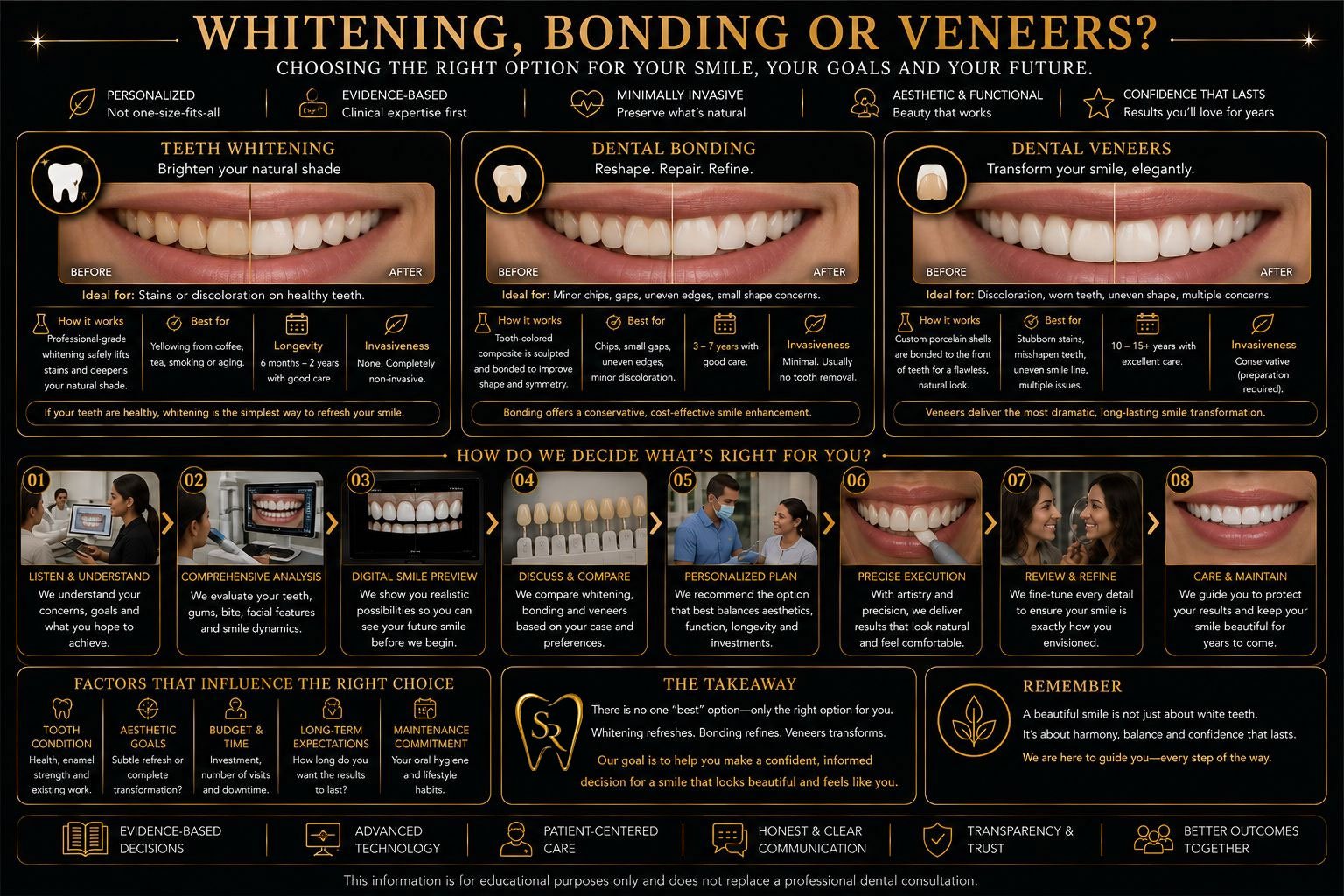
Whitening primarily changes colour. Bonding can modify selected areas of shape and proportion. Veneers can change several esthetic characteristics together. The right choice depends on what actually needs to change.
How Are the Three Different?

1. Natural teeth aren't one flat shade
Professional whitening aims to lighten natural teeth without changing their shape or removing tooth structure.
For someone who is generally happy with their smile but wants it brighter, this may be all that is required.
However, whitening does not significantly alter tooth shape, position or proportions, and existing restorations do not whiten in the same way as natural teeth.

2. Bonding — when small changes can make a difference
Composite bonding can add material to selected areas of a tooth to modify shape, close certain spaces or refine proportions.
It can often be performed with little or no removal of healthy tooth structure, depending on the clinical situation.
The trade-off is that composite may require maintenance over time and behaves differently from ceramic restorations.

3. Veneers — when several characteristics need to change
Veneers can alter colour, shape, proportions and some aspects of tooth appearance simultaneously.
They may be appropriate when the desired result cannot be achieved predictably with whitening or bonding alone.
But veneers are a restorative treatment—not simply an upgraded version of whitening—and should be considered accordingly.
Can Treatments Be Combined?
Yes. The most conservative plan may sometimes use more than one technique rather than one technique everywhere.
For example, whitening may improve the overall colour first, while limited bonding is then used only where shape requires refinement.
This can sometimes avoid treating teeth that do not actually need restorative intervention.
The SR Perspective
Esthetic treatment should not begin by choosing a procedure. It should begin by identifying what you would genuinely like to change about your smile.
If the concern is colour, change colour.
If it is a small proportion, correct the proportion.
More extensive restorative treatment should be considered when the desired result genuinely requires it.
The sophistication of esthetic dentistry is not measured by how much we change—but by how precisely we know what not to change.
Key Takeaway
Whitening, bonding and veneers solve different esthetic problems.
Whitening is generally the least structurally invasive, bonding can provide selective changes in shape, and veneers can address several characteristics together when appropriately indicated.
The best option is the one that achieves your objective while preserving as much healthy natural tooth structure as reasonably possible.
