
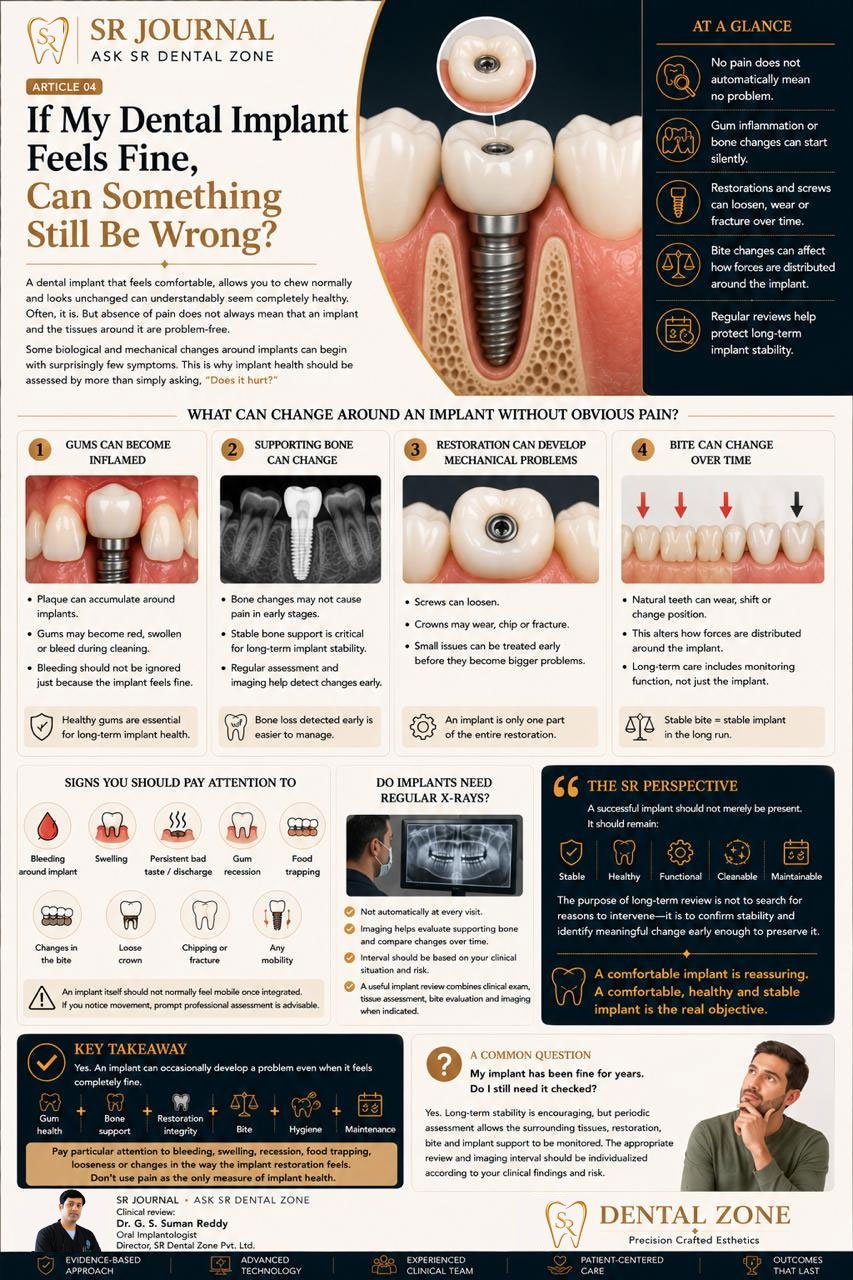
If My Dental Implant Feels Fine, Can Something Still Be Wrong?
📅 Sep 7, 2026 | 🕒 5 min read | 👤 Dr. G. S. Suman Reddy
A dental implant that feels comfortable, allows you to chew normally and looks unchanged can understandably seem completely healthy.
Often, it is.
But absence of pain does not always mean that an implant and the tissues around it are problem-free.
Some biological and mechanical changes around implants can begin with surprisingly few symptoms. This is why implant health should be assessed by more than simply asking, "Does it hurt?"
What Can Change Around an Implant Without Obvious Pain?

1. The gums around an implant can become inflamed
Dental implants cannot develop tooth decay, but plaque can still accumulate around them.
The surrounding tissues may become inflamed, sometimes producing redness, swelling or bleeding during cleaning.
Because this inflammation may initially cause little discomfort, bleeding around an implant should not simply be ignored because the implant itself feels fine.

2. Supporting bone can change
Long-term implant stability depends on the health of the bone surrounding the implant.
Changes in supporting bone may not necessarily produce pain in their early stages.
Clinical examination—and imaging when appropriate—can help determine whether the supporting structures remain stable.

3. The restoration can develop mechanical problems
An implant is only one component of the treatment.
The crown, bridge, screw or other restorative components attached to it are exposed to repeated functional forces.
Over time, components may wear, loosen, chip or fracture.
A small mechanical change may sometimes be detected during examination before it develops into a more significant problem.

4. Your bite can change
The implant itself does not move like a natural tooth.
Natural teeth, however, can wear, shift or change position over time, and restorations elsewhere in the mouth can alter the bite.
This means the way forces are distributed around an implant can change even after years of successful function.
Long-term implant care includes monitoring function—not just the implant itself.
What Signs Should You Pay Attention To?
An implant should be assessed if you notice:
Bleeding around it · Swelling · Persistent bad taste or discharge · Gum recession · Food trapping · Changes in the bite · A loose crown · Chipping or fracture · Any mobility
An implant itself should not normally feel mobile once integrated. If you notice movement, prompt professional assessment is advisable.
Do Implants Need Regular X-Rays?
Not automatically at every visit.
Imaging can be valuable for evaluating supporting bone and comparing changes over time, but the need and interval should be based on the clinical situation, previous findings and individual risk.
A useful implant review combines clinical examination, tissue assessment, functional evaluation and appropriate imaging when indicated.
The SR Perspective
A successful implant should not merely be present. It should remain:
Stable. Healthy. Functional. Cleanable. Maintainable.
This is why implant maintenance should not begin only when something hurts
The purpose of long-term review is not to search for reasons to intervene—it is to confirm stability and identify meaningful change early enough to preserve it.
A comfortable implant is reassuring.
A comfortable, healthy and stable implant is the real objective.
Key Takeaway
Yes. An implant can occasionally develop a problem even when it feels completely fine.
Long-term implant health depends on:
Gum health + Bone support + Restoration integrity + Bite + Hygiene + Maintenance
Pay particular attention to bleeding, swelling, recession, food trapping, looseness or changes in the way the implant restoration feels.
Don't use pain as the only measure of implant health.
